


The Global Marketplace for Deepfake Abuse
Deepfake abuse is no longer limited to a few skilled users. Learn how AI tools, online communities, and global payments have turned it into a worldwide business.
On this page
A few years ago, creating a realistic fake video was something only a small group of people could do.
It took technical skill, expensive hardware, and a lot of patience.
For most people, it was simply out of reach.
That is no longer true.
Today, someone with a laptop and an internet connection can find tools that swap faces, clone voices, and generate realistic videos in a matter of minutes. Some tools are free. Others are sold as easy-to-use apps or online services.
What used to be a technical hobby has turned into a worldwide market.
And like many online markets, it has grown much faster than the rules meant to control it.
Deepfake Creation Has Become Much Easier
The biggest reason this market has grown is simple.
The tools have become easier to use.
Open-source models can now generate realistic images and videos with only a few clicks. Voice cloning systems can recreate someone’s speech from a short audio sample.
A person no longer needs to understand machine learning.
They only need source material and a clear goal.
Researchers at Sensity AI and other monitoring groups have documented how the number of synthetic videos online has increased sharply as these tools have become more accessible.
This pattern follows a familiar rule in technology.
When tools become cheaper and easier to use, more people adopt them.
Online Communities Have Created a Service Economy
Not everyone wants to make Deepfakes themselves.
Many people simply hire someone else to do it.
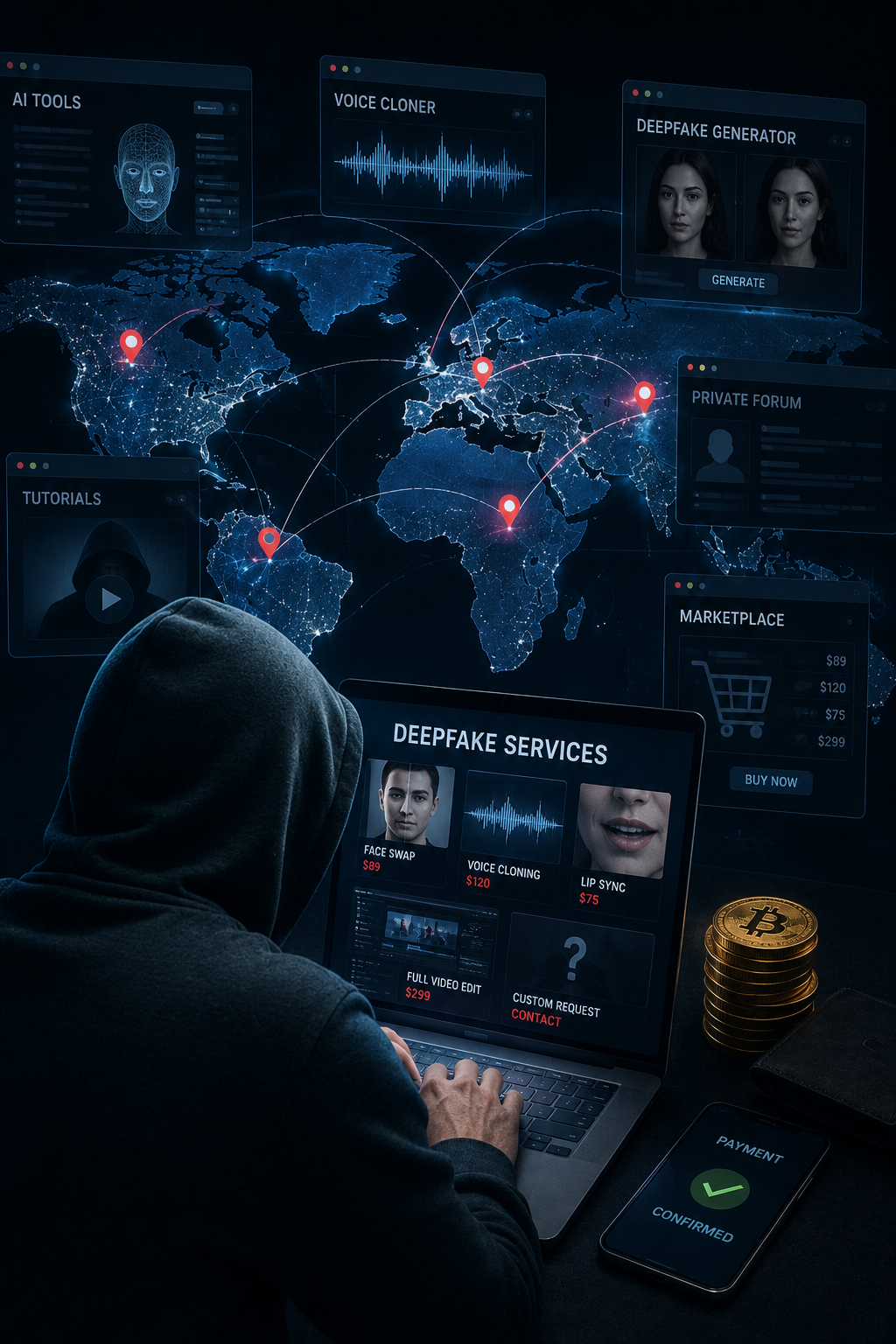
On forums, private chat groups, and freelance marketplaces, sellers advertise services such as:
- Face swapping
- Voice cloning
- Lip syncing
- Video editing
- Synthetic profile creation
These listings often look like any other digital service.
There are examples of previous work, turnaround times, and customer reviews.
In some communities, prices range from a few dollars for simple edits to much higher amounts for custom projects.
This turns synthetic media creation into a business model rather than a one-off activity.
Cryptocurrency Makes Payments Harder to Track
Many of these services are paid for using cryptocurrency.
That matters for two reasons.
First, it allows buyers and sellers in different countries to transact quickly.
Second, it can make it harder to identify who was involved.
This does not mean cryptocurrency causes abuse.
It simply removes some of the friction that would normally come with international payments.
The same technology that supports legitimate online commerce can also support anonymous transactions.
The Market Operates Across Borders
One of the biggest challenges is that this market is global.
A buyer may be in one country.
The seller may be in another.
The servers hosting the content may be located somewhere else entirely.
This makes enforcement difficult.
Laws vary widely between countries, and many jurisdictions are still developing rules for synthetic media.
Even when harmful content clearly violates privacy or consent, identifying the responsible party can be complicated.
Detection and Moderation Are Always Catching Up
Google and Microsoft are developing deep fake detection software to help prevent this type of abuse.
In addition to those efforts, researchers and developers are creating watermark technology and a standard for tracking origin (provenance) that can be used by industry as a whole through the Coalition for Content Provenance and Authenticity.
Work like that is really valuable; however will most likely be a response-based system.
Before there are many reports of Malicious/Abusive Content appearing in the Media, a lot of the harm caused will have already occurred.
That's why so many Experts suggest using Pre-emptive Methods to create Platform-Wide Policies defining types of Content that should always remain Offline, and Developing New Systems that Allow Reporting of Harmful Content to occur at a faster rate.
Economic Incentives Drive the Market
The growth of this market is not only about technology.
It is also about incentives.
If there is demand, someone will try to supply it.
That is true for nearly every online service.
As synthetic media tools become more powerful, the cost of producing realistic content continues to fall.
At the same time, the potential to earn money remains.
That combination creates strong incentives for new sellers to enter the market.
Not All Synthetic Media Is Harmful
It is important to separate harmful Deepfakes from legitimate uses of AI.
The difference between deep fakes and other forms of artificial intelligence (AI) is based on intent and use, with many positive applications for synthetic media, such as:
• Movie production,
• Video game development,
• Dubbing,
• Education and
• Creative works.
There are a number of developers who have released open models to support research and the process of creative experimentation.
The problem is not the technology itself.
The problem is what happens when tools are used without consent or for deceptive purposes.
That distinction matters when discussing regulation and responsible design.
The Next Challenge Is Governance
The marketplace for Deepfake abuse is growing because it sits at the intersection of several trends.
AI tools are improving.
Costs are falling.
Global payments are easier.
Online communities share knowledge quickly.
No single company or country can solve the problem alone.
The long-term response will likely involve a mix of better detection, stronger laws, faster moderation, and international cooperation.
Conclusion
Deepfake abuse has moved beyond being an underground niche to become a globalized marketplace for digital content manipulation.
Access to these tools has never been simpler; services have no geographical boundaries, and the business models that support this type of abuse operate on top of the same technologies that make so much of today's Internet possible.
Therefore, understanding the scope of this marketplace helps show us that our challenges are bigger than just technology. They are economic, incentivized, and will spread at a rapid rate as soon as there is enough consumer demand to do so.



