The Future of Identity Verification in an AI-Generated World
Explore how AI-generated images, voices, and videos are changing identity verification and what the future of digital trust may look like.
On this page
For a long time, proving who you were felt pretty simple.
You typed in a password.
Maybe your phone sent you a code.
Sometimes you showed your ID.
That was usually enough.
Most people never thought twice about it.
But that is starting to change.
AI can now create fake photos, clone voices, and generate videos that look surprisingly real. Things people once trusted as proof are becoming easier to copy.
That does not mean identity verification is failing.
It means the rules are changing.
Why Familiar Signals Matter Less
In years past, it felt reassuring to see an individual's face on a computer screen via webcam or other visual means.
Most individuals would assume they were communicating with a live individual if their voice sounded familiar and the video appeared typical.
However, today, that is not a reliable assumption.
An individual's realistic photo can now be produced within minutes.
A voice can now be duplicated from just seconds of audio.
A video can also be easily created to appear as if it were recorded by a live person, which appears believable to those who do not scrutinize the video.
This is significant about this trend.
Familiar signals that have been used for many years as indicators of authenticity are becoming easier to produce.
Passwords Still Matter, but They Are Not Enough
Passwords are still useful.
But they have always had weaknesses.
People reuse them.
They choose simple ones.
They fall for phishing emails.
That is why many websites added extra steps, like text message codes and authentication apps.
Now, AI is creating a different kind of challenge.
Even if your password is safe, someone may try to imitate your face or voice.
That is why security systems are starting to look beyond what you know.
Your Face Is Becoming Part of the Process
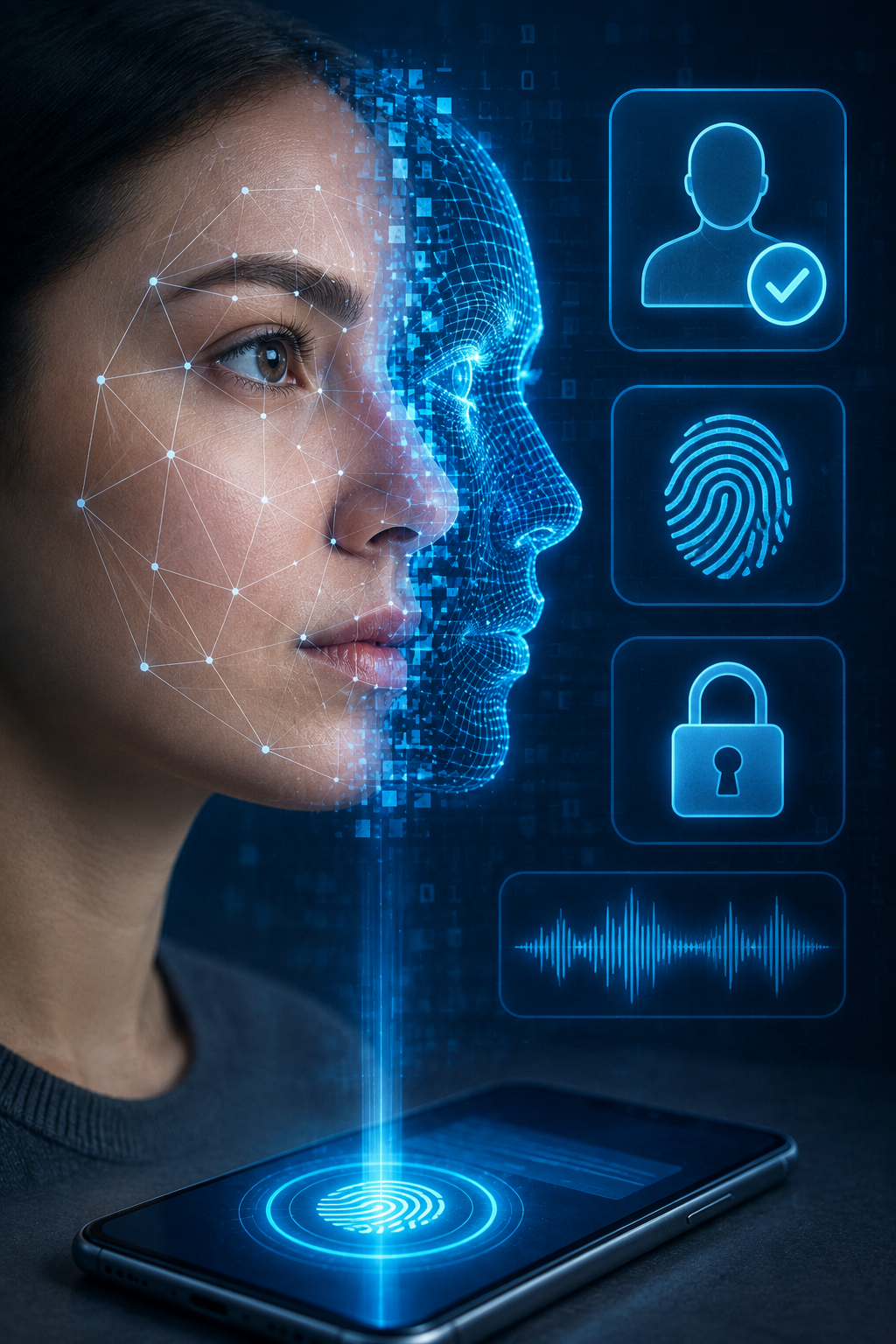
Many devices now use biometrics.
That includes fingerprints, facial recognition, and voice matching.
Companies like Apple and Google helped make these tools part of everyday life.
For many people, unlocking a phone with their face feels normal.
It is fast and convenient.
But biometrics come with a trade-off.
You can change a password.
You cannot easily change your face or fingerprint.
That means companies need to protect this data very carefully.
The Rise of Liveness Checks
You may have noticed some apps asking you to blink, smile, or turn your head.
These are called liveness checks.
They are designed to confirm that a real person is in front of the camera.
The goal is to stop someone from using a photo, video, or synthetic image to pass verification.
This extra step can feel a little awkward.
But it is becoming more common as AI tools improve.
Identity Checks Are Becoming More Layered
The days of relying upon just one item (such as a password) to authenticate are behind us.
We can expect that in the near future, there will be many items used at the same time to determine if an individual is who they say they are.
Examples may be your smartphone, your physical location, how you type on your keyboard, facial recognition software, etc. Think of this as a puzzle.
One side of the puzzle is helpful.
Many sides of the puzzle make up a much better picture than just looking at one side.
Using layers to verify identity will likely make it much harder for the bad guys to succeed.
Privacy Will Matter More Than Ever
As identity checks become more advanced, people will ask an important question.
What happens to all of this data?
That concern is valid.
We don't want to provide sensitive information about ourselves to a company (or organization) with no idea how our data is being collected or stored.
Data protection regulations (like the GDPR in Europe) require companies to be far more open regarding what data they're collecting and why.
You May Carry Verified Credentials Digitally
One day, you might no longer have to send your identification for each site you go to.
Instead, you will most likely use a secure digital wallet (like your mobile) to keep all of your validated credentials.
The World Wide Web Consortium is one organization working to create systems that allow individuals to show proof of certain characteristics about themselves, e.g., being at least age 18, but not share information they do not want to reveal.
This will give you, the user, much greater control.
Trust Is the Real Goal
The purpose of identity verification is not just to block fraud.
It is to help people feel confident that they are dealing with real people and legitimate services.
As AI improves, that job becomes more challenging.
But it also creates an opportunity to build better systems.
The strongest solutions will be the ones that protect security while respecting privacy.
Conclusion
AI is changing how people prove who they are.
Photos, voices, and videos are no longer as trustworthy as they once seemed.
As a result, identity verification is becoming more layered and more thoughtful.
Passwords will still matter.
Biometrics will become more common.
Privacy will play a bigger role.
In the years ahead, proving your identity will depend on more than one signal.
It will depend on systems designed to look at the whole picture.