AI Porn vs Deepfaking: Ethical Boundaries and Misconceptions
This article outlines the key differences between AI Porn and Deepfakes, emphasizing the need for clearer distinctions to guide ethical use and legal protections.
On this page
AI Porn vs Deepfaking: Ethical Boundaries and Misconceptions
Contents
Key Differences Between AI Porn and Deepfaking
The Evolution of Artificially Generated Adult Content
Deepfaking: Transforming Non-Consensual Pornography
The Ethical Dilemmas Of Deepfake Pornography
The Role of Media in Perpetuating Misconceptions
With growing concerns surrounding the misuse of Deepfake technology, this article seeks to clarify the differences between AI Porn and Deepfaking. The interchangeability of these terms has contributes to a widespread perception that all AI-generated adult content is harmful, overshadowing the nuanced distinctions between the two forms of media.
Key Differences Between AI Porn and Deepfaking
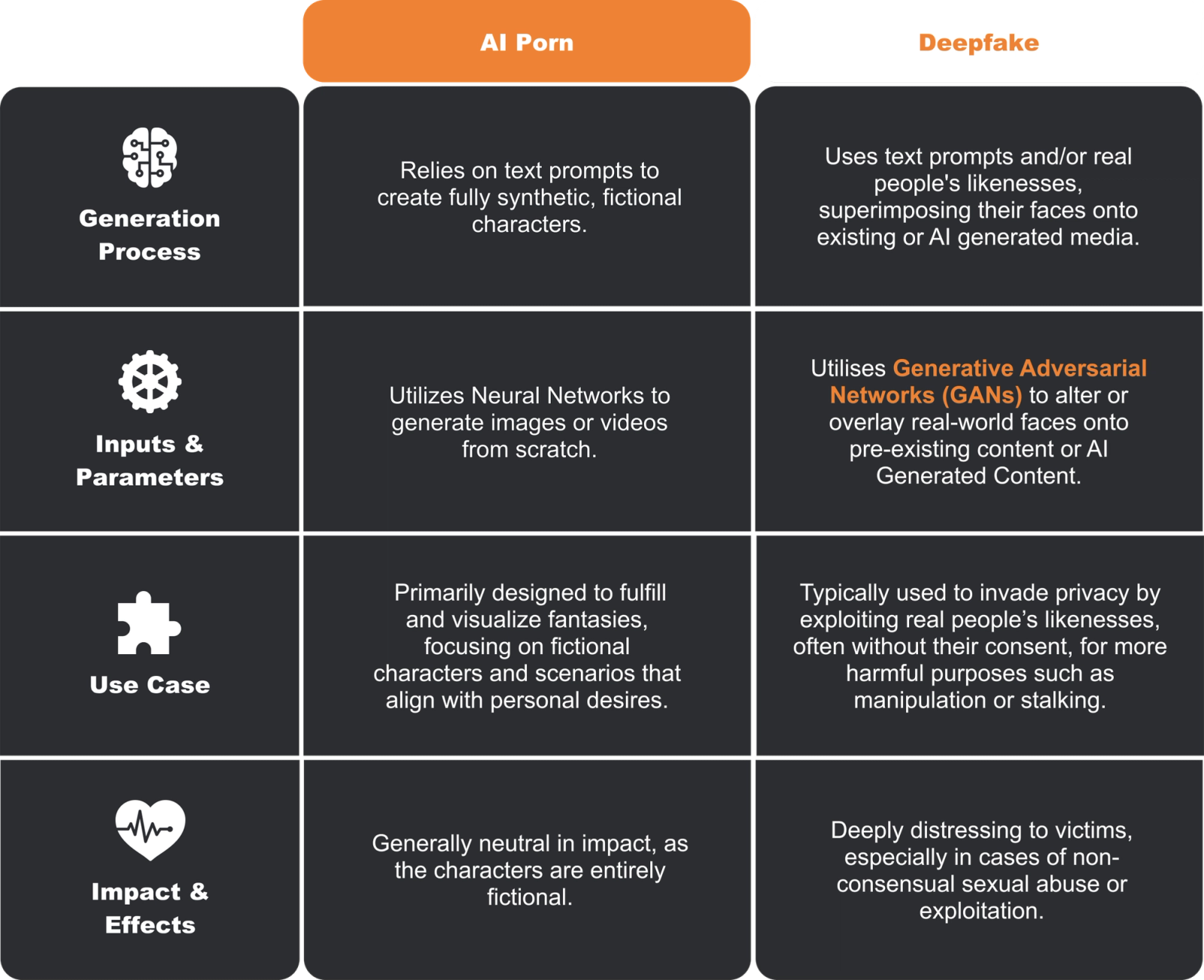
While both AI Porn and Deepfakes involve AI-generated content, it’s important to note the key differences in how these technologies are applied.
The Evolution of Artificially Generated Adult Content
The popularity of Generative AI gained momentum in 2021 with platforms like DALL-E and Midjourney which allowed users to generate intricate visuals from text prompts. By 2022-2023, there was a surge in adult-focused AI content, which led to the increased popularity of AI Porn.
AI Porn refers to the broader category of adult content generated by artificial intelligence, encompassing a range of formats including photorealistic adult images and digital adult art. What sets AI Porn apart is that all the subjects involved are entirely synthetic & fictional, created purely by algorithms without referencing real individuals.
Deepfaking: Transforming Non-Consensual Pornography
On the other hand, Deepfaking is a distinct subset of AI technologies, representing just one specialized application within the broader category of AI Porn. Rather than entirely fictional outputs, Deepfakes use real people’s faces to generate content. The technology primarily relies on Generative Adversarial Networks (GANs), which superimpose the likeness of a real person onto existing images, videos, or AI Generated content, creating highly realistic simulations of individuals engaging in activities they never participated in. Deepfakes can be created by uploading a saved image of someone's face directly into an AI generator, which then uses that face to generate manipulated content. They can also be generated by directly typing in a well-known name. However, AI platforms can implement keyword filters and recognition systems to block names associated with real individuals, reducing the misuse of Deepfake technology.
The increased accessibility of Deepfake technologies, along with lagging legislation, significantly affected the recent rise of non-consensual pornography. During the generative AI boom of 2023, some AI adult websites began offering Deepfake services disguised as personal image uploads, allowing users to create explicit content of real people without their consent. This accessibility made it easier for individuals to exploit the technology, exacerbating the ethical and legal issues surrounding deepfakes and contributing to high-profile cases involving the misuse of these services.
A widely publicised scandal involving Non-Consensual Intimate Images (NCII) early 2024 involved the creation of non-consensual explicit images of Taylor Swift, which were shared on X (formerly Twitter). This incident raised public outcry and prompted discussions about legal reforms, including a proposed U.S. bill to criminalize such uses of AI in pornography.
Deepfake technology is also frequently used to produce child sexual abuse material (CSAM) and revenge porn and Revenge Porn, further amplifying the ethical concerns. In response to these growing threats, states like Washington introduced legislation targeting Deepfakes, driven in part by high-profile cases of minors being victimized by the technology.
The motivations behind the creation of AI Porn and Deepfakes differ significantly. AI-generated porn, includes the creation of purely fictional characters, is primarily driven by a desire to explore fantasies and satisfy sexual preferences. On the other hand, Deepfakes often serve more invasive purposes, with creators using AI technology to superimpose real people's faces into explicit content without consent. This misuse is linked to a desire to manipulate or exploit individuals, as seen in cases of non-consensual intimate images (NCII) and stalking behavior.
The Ethical Dilemmas Of Deepfake Pornography
The ethical implications of Deepfake pornography are profound, primarily due to the unauthorized use of individuals' images without their consent. Deepfakes have been widely condemned for violating privacy, damaging reputations, and contributing to the spread of misinformation. Victims of Deepfake pornography often suffer severe psychological harm, including emotional distress, anxiety, and long-term reputational damage. Deepfakes also erode broader societal norms around consent, making it difficult to foster a culture of respect and ethical practices in digital media.
Consent violations are central to the harm caused by Deepfakes. In many cases, the individuals depicted in Deepfakes are unaware of their creation, making it impossible for them to consent to the use of their likeness. This not only creates a personal invasion of privacy but also undermines efforts to promote consent and ethical standards within the adult entertainment industry.
Furthermore, legal frameworks have not yet fully caught up with the complexities introduced by Deepfake technology. Many existing laws on pornography and privacy do not adequately address the unique challenges posed by Deepfakes, creating loopholes that allows NCII and CSAM to proliferate. As a result, there is a need for stronger legal protections and industry standards to combat the psychological, reputational, and societal damage caused by Deepfake pornography.
The Role of Media in Perpetuating Misconceptions
Mainstream media often conflate AI porn with Deepfakes, leading to a general perception that all AI-generated adult content is unethical or harmful. This lack of distinction between the two has caused many to view AI Porn as a whole in the same light as Deepfakes, despite the ethical differences between them. The emphasis on harmful, non-consensual uses of Deepfakes in media coverage reinforces negative associations with all AI generated adult content, even though AI Porn is primarily focused on fictional subjects that do not involve real people.
Moreover, mainstream coverage tends to overlook the nuances between these two technologies and doesn't clearly differentiate between them. As a result, AI Porn is often grouped with Deepfakes, perpetuating a negative view of and misunderstanding of the technology and its applications.
As AI-generated adult content continues to evolve, understanding the distinctions between AI Porn and Deepfakes will be crucial for shaping legal protections, ethical guidelines, and responsible technological advancement.
Read More
Navigating the Ethical and Legal Landscape of AI Porn Generators
What Can AI Porn Platforms Do To Prevent the Creation of CSAM and NCII?
The Ethical Implications of Deepfake Porn